PanLink Overview: A High-Performance CALPHAD Data Engine for ICME and AI
PanLink is a core enabling module of the third-generation Pandat software — a high-performance CALPHAD data engine built for large-scale Integrated Computational Materials Engineering (ICME) and AI-driven materials design. It transforms thermodynamic and kinetic calculations from a computational bottleneck into a high-speed, reusable data service, enabling simulations at billion-scale call frequencies while preserving full thermodynamic consistency.
PanLink Architecture
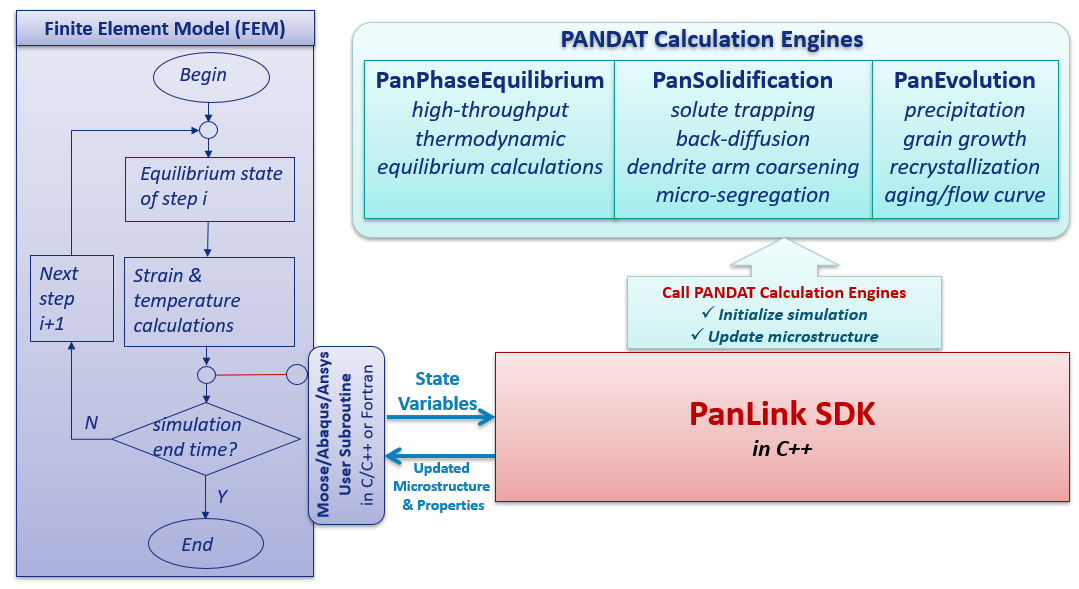
Traditional direct coupling between CALPHAD engines and external solvers — FEM, phase-field, or AI optimizers — suffers from severe computational inefficiency due to repeated, redundant equilibrium and property calculations. PanLink overcomes this through a data-centric architecture that dynamically groups, manages, and reuses CALPHAD results across composition, temperature, pressure, and phase-space dimensions. This approach eliminates redundancy without sacrificing accuracy.
ICME & FEM Integration
Directly couples with major FEM solvers (Ansys, Abaqus, MOOSE) and in-house codes. Supports time-dependent, location-specific CALPHAD queries for heat treatment, casting, and microstructure evolution — at industrial mesh scales.
AI-Ready Data Engine
Rapidly delivers consistent, reusable CALPHAD data for AI-driven materials design loops — design-space screening, hypothesis testing, and property optimization — grounded in physics-based thermodynamics and kinetics.
Rich CALPHAD Property Access
Provides structured C SDK access to phase equilibria, compositions, chemical potentials, driving forces, entropy, heat capacity, diffusion coefficients, mobility, and extensible custom properties through clean, pointer-based interfaces.
1. Cao, W., Zhang, F., Kadirvel, K., Chen, S., Payton, E., & Krug, M. (2025). PanEvolution: Integrating CALPHAD, microstructure modeling, and finite element method. Calphad, 90, 102851
2. A second publication on PanLink is forthcoming.
Key Features
- Third-Generation Architecture: specifically engineered for large-scale ICME workflows and seamless AI model integration.
- Billion-Scale Performance: High-performance data engine enables thermodynamic and kinetic simulations at speeds required for industrial-scale FEM coupling.
- Intelligent Data Management: PanDataNet utilizes dynamic grouping and reuse strategies to eliminate computational redundancies.
- Universal Solver Integration: PanLink provides a standardized bridge to couple with major FEM solvers like Ansys, Abaqus, and Moose, as well as custom in-house codes.
- Holistic Simulation: comprehensive modeling capabilities covering precipitation, diffusion, solidification, and complex microstructure evolution.
- AI-Ready Data Generation: Rapidly generate massive, high-fidelity datasets to train and validate machine learning models for materials discovery.
Modules
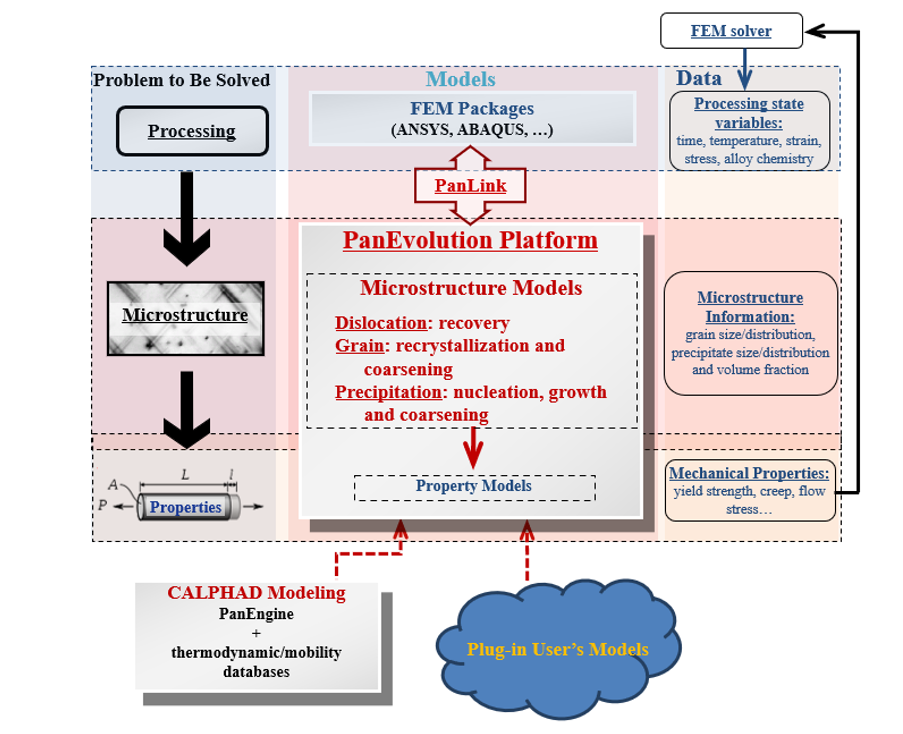
PanLink is the innovative bridge that connects the core Pandat engine with external solvers. Built as a high-efficiency Dynamic Link Library (DLL) in C/C++, it enables the direct, runtime coupling of CALPHAD and microstructure modeling with Finite Element Analysis (FEA). Its decoupled architecture ensures that multiple FEM solvers can be integrated without needing to recompile the core engine, offering maximum flexibility and extensibility.
PanEvolution
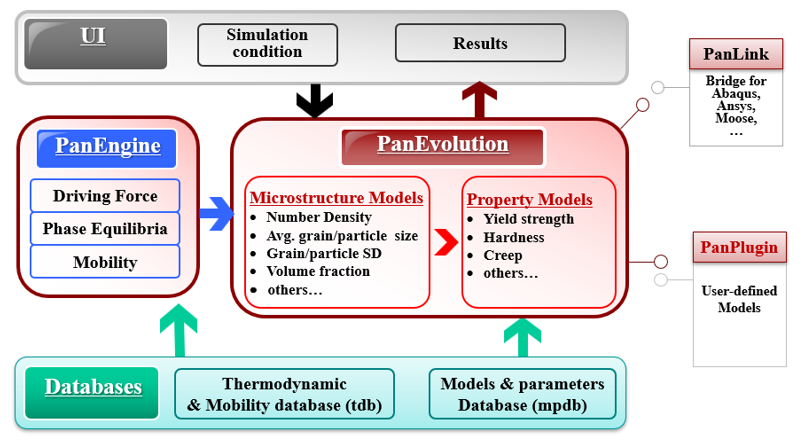
PanEvolution is the premier platform for simulating microstructure evolution. By tightly coupling CALPHAD thermodynamics with kinetic models, it accurately predicts changes during conventional manufacturing processes such as precipitation hardening, recrystallization, grain growth, and coarsening. Its open architecture empowers users to integrate custom property models, ensuring the tool adapts to specific research or industrial needs.
PanPhaseEquilibrium
PanPhaseEquilibrium can perform billions of the point calculations efficiently using PanDataNet. PanDataNet serves as the high-speed data backbone of the system. It addresses the "big data" challenge in ICME by implementing smart caching, dynamic grouping, and efficient data reuse strategies. This module is the key enabler for achieving billion-scale calculation speeds, making it feasible to run high-fidelity simulations on large-scale FEM meshes.
PanSolidification
PanSolidification provides specialized modeling for the critical solidification phase. It predicts essential parameters such as phase fractions, latent heat release, and microsegregation profiles. When coupled with FEM heat transfer solvers, it enables the accurate simulation of casting defects and microstructure formation in as-cast components.
Case Studies & Gallery
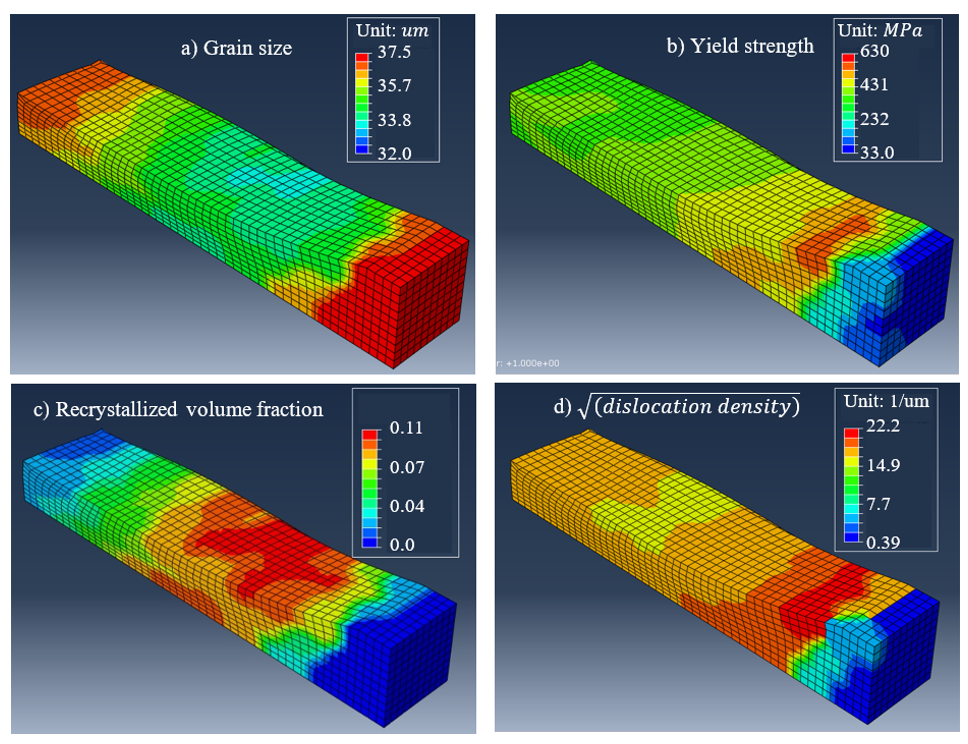
Rolling ( ABAQUS )
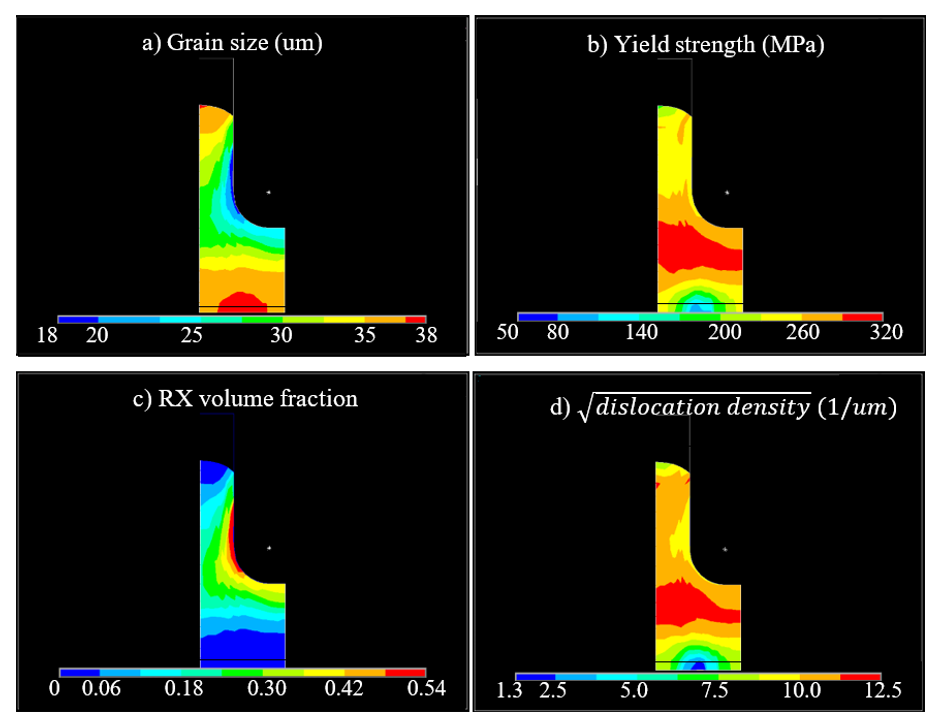
Forging ( ANSYS )
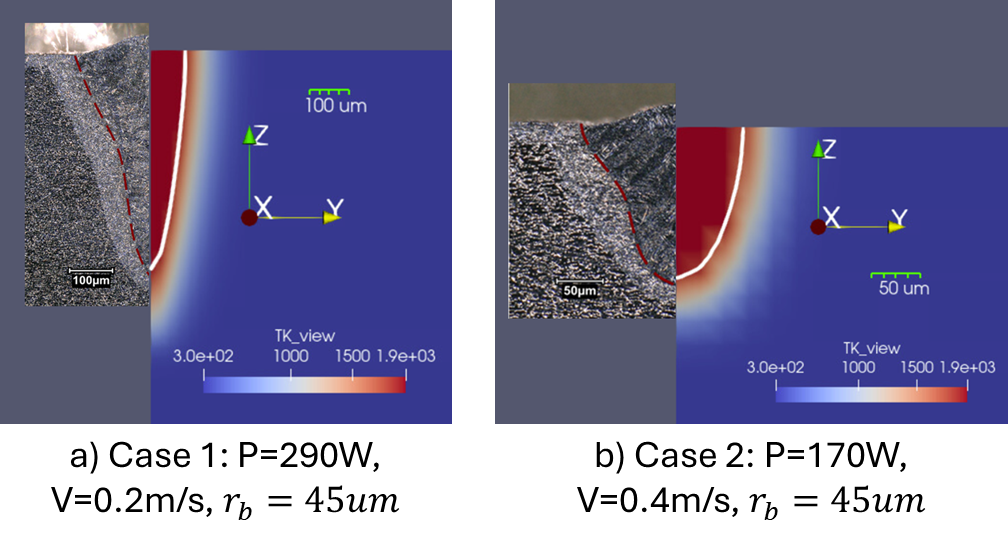
Additive Manufacturing (LPBF)