
Analytical models for Stress-Strain (σ-ε) curve at low/ambient temperatures
In PanEvolution, the modified tri-stage constitutive model [2023Yan] was adopted to describe the σ-ε behaviors at low to ambient temperatures as shown in Figure 5.5
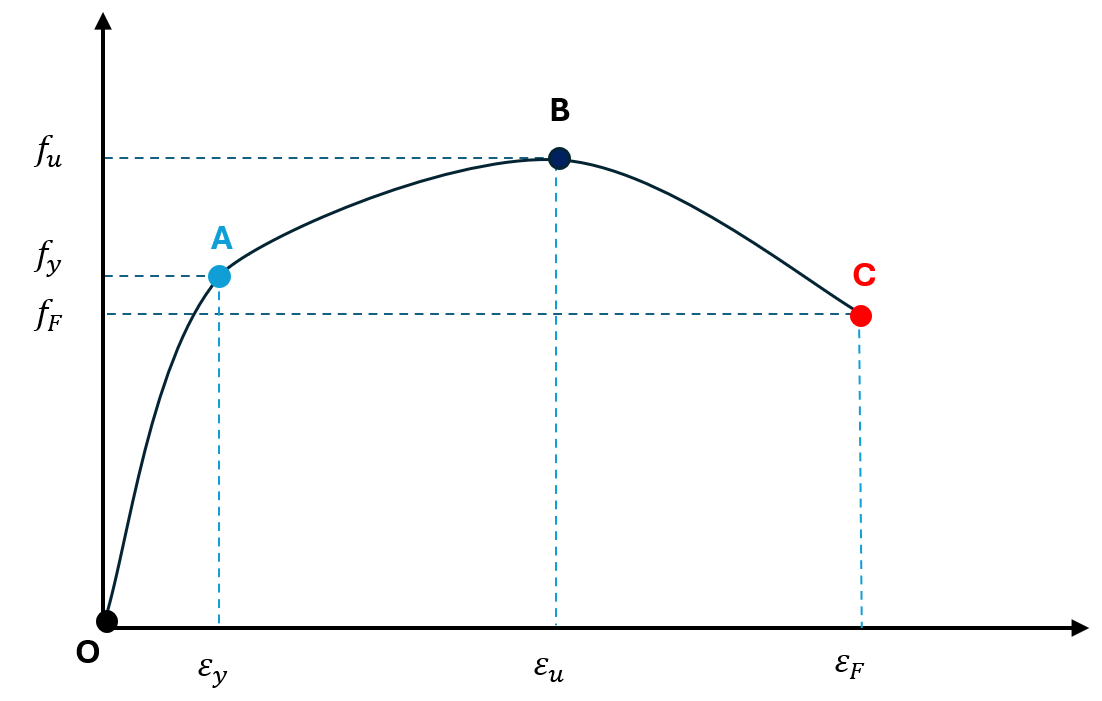
Figure 5.5: The tri-stage model at low/ambient temperatures
In this model, before or after the yielding point A, the relationship between stress (σ) and strain (ε) can be described by the modified RO model by Hill [1944Hill]. Beyond the ultimate strength point B, the recession branch of σ-ε models is adopted [2019Tao]. Eq. 5.62 - Eq. 5.64 summarizes the models at different stages:

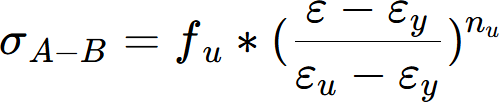

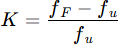
Where fy ( or εy ), fu ( or εu ) and fF ( or εF ) are yield strength ( or strain ), ultimate strength ( or strain ) and fracture strength ( or strain ), respectively. ny and nu are the strain-hardening indexes before and after yielding point while nF is the recessing index. These parameters influence the material's behavior and are often different from alloy systems. Constant or analytical expression of these parameters can be defined in the KDB and then optimized for various applications.
[1944Hill] H.N. Hill, Determination of stress-strain relations from the offset yield strength values, Technical Note No. 927, National Advisory Committee for Aeronautics, Washington, D.C., USA, 1944.
[2019Tao] Z. Tao, X.-Q. Wang, M.K. Hassan, T.-Y. Song, L.-A. Xie, Behaviour of three types of stainless steel after exposure to elevated temperatures, Journal of Constructional Steel Research, 152 (2019) 296-311.
[2023Yan] J.-B. Yan, B. Zhang, Y. An, Stress-strain models and numerical simulations of high-strength steel Q690E and Q960E at low temperatures, Journal of Constructional Steel Research, 207 (2023) 107957.