

PanLink SDK · Third-generation Pandat
PanLink
A high-performance CALPHAD data engine for ICME and AI
PanLink is a core enabling module of the third-generation Pandat software, built for large-scale Integrated Computational Materials Engineering (ICME) and AI-driven materials design. It turns thermodynamic and kinetic calculations from a computational bottleneck into a high-speed, reusable data service, so simulations can make calls at billion-scale frequencies while keeping full thermodynamic consistency.
109
thermodynamic & kinetic evaluations per simulation
103–106×
efficiency gain over direct coupling in application cases
C API
one bridge to FEM, phase-field and AI solvers
The PanLink framework
PanLink sits between your simulation framework and the Pandat calculation engines. FEM solvers, phase-field codes, other ICME frameworks and AI-driven workflows all connect through the same interface, and reach phase equilibrium, solidification, precipitation, and recrystallization & grain growth models. Underneath, an efficiency and data-management layer makes calls at this scale affordable.
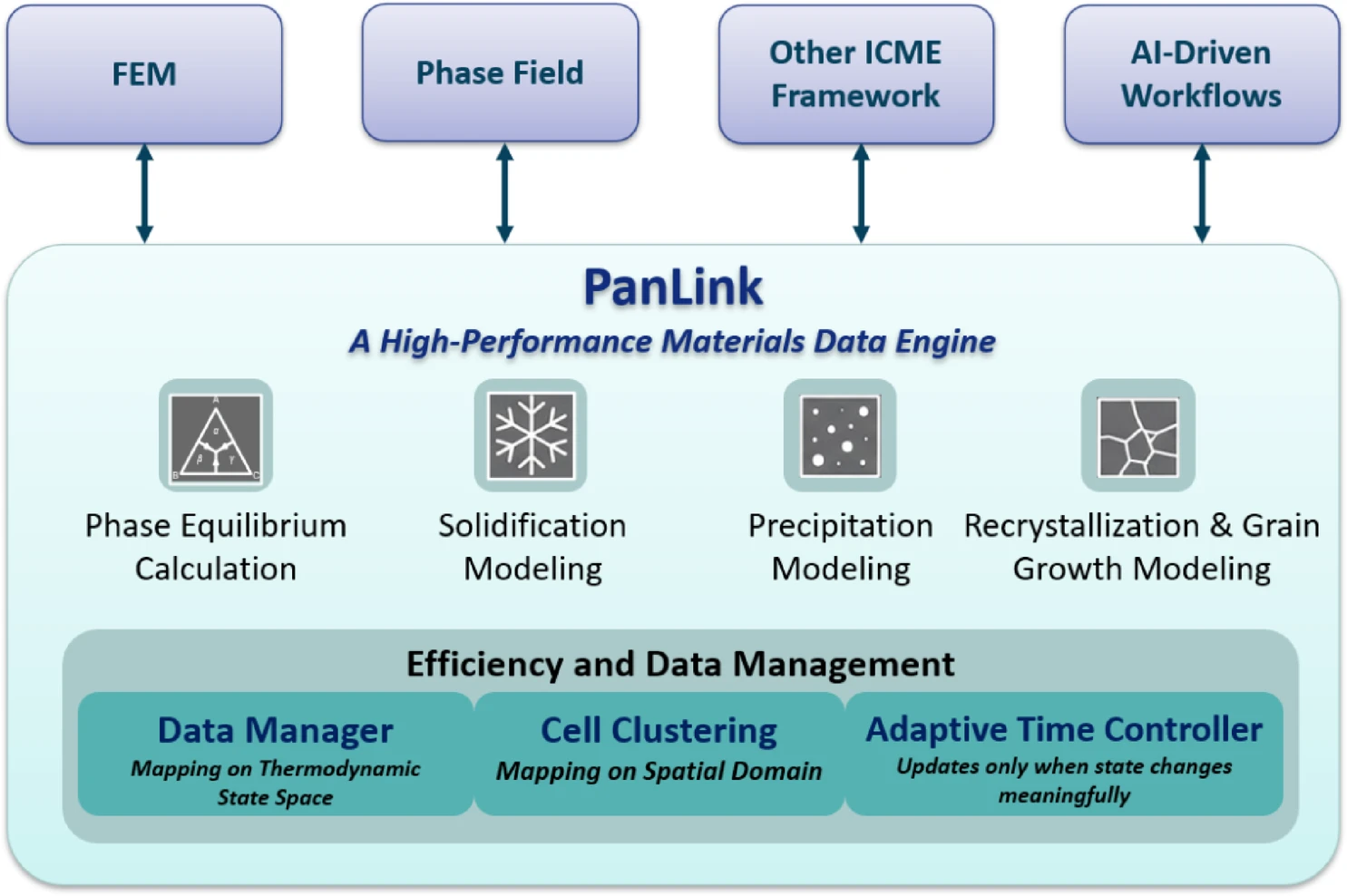
Data manager
Mapping on the thermodynamic state space. Through PanDataNet, smart caching, dynamic grouping and reuse of CALPHAD results across composition, temperature, pressure and phase space remove redundant calculations without sacrificing accuracy.
Cell clustering
Mapping on the spatial domain. Mesh elements or nodes under similar local conditions are grouped, so one calculation serves many cells. Typical runs use from 100 to 10,000 clusters.
Adaptive time controller
Updates only when the local state changes meaningfully. Cells whose conditions have barely moved since the last step reuse their results, so long processing histories stay fast.
Why a data engine
Classic CALPHAD applications such as a phase diagram or a solidification simulation need a few thousand thermodynamic calculations at most, and can call the engine directly. A 3D phase-field or FEM simulation can need millions to billions of them. Direct coupling then repeats the same equilibrium and property calculations over and over, and becomes the bottleneck. PanLink replaces it with a data-centric architecture.
1996–2010 · Generation 1
Thermodynamics
Phase diagram and thermodynamic calculations.
2010–2020 · Generation 2
Kinetics simulation
Precipitation, diffusion and solidification. Direct coupling with thermodynamic calculation, at the scale of thousands of calls.
2020–present · Generation 3
Materials data engine
ICME and AI: phase-field simulation, FEM integration, high-throughput calculation and machine learning, powered by PanLink and PanDataNet at the scale of millions to billions of calls.
From solver-centric to data-centric
Grouping, managing and reusing results across composition, temperature, pressure and phase space removes the redundancy instead of approximating it. In the application cases below, this brought efficiency gains of three to six orders of magnitude while staying thermodynamically consistent.
How it works
Your solver keeps doing what it does best. At each step it hands PanLink the local state, and PanLink returns the material data for the next step.
Your solver
An FEM, phase-field or AI model advances in time and passes local state variables, such as temperature, thermal gradient, strain and composition, through the user-material interface.
PanLink
Clusters similar cells, reuses results through PanDataNet, and calls PanEvolution, PanSolidification or PanPhaseEquilibrium only where new data is needed.
Material data back
Phase data, microstructure state and material properties at every node, ready for the solver’s next step.
No recompiling the core engine
PanLink is a dynamic library (.dll / .so) written in C/C++. Its decoupled architecture lets several FEM solvers be integrated without recompiling the Pandat engine, and removes the need to pre-build static property lookup tables: properties are computed on demand from the real processing conditions.
Modules PanLink connects
PanLink gives external solvers runtime access to three specialized Pandat modules.
PanEvolution
- precipitation hardening and coarsening
- recrystallization, including dynamic recrystallization
- grain growth with Zener pinning
- dissolution during solution treatment
- open architecture for custom property models
PanSolidification
- phase fractions and latent heat release
- microsegregation profiles
- crack susceptibility index (CSI)
- secondary dendrite arm spacing (SDAS)
- casting defects and as-cast microstructure
PanPhaseEquilibrium
- billions of point calculations via PanDataNet
- phase equilibria and compositions
- temperature-dependent thermophysical properties
- heat capacity, thermal conductivity, density
- feasible on large-scale FEM meshes
Rich CALPHAD property access through a clean, pointer-based C SDK:
Key features
Third-generation architecture
Engineered for large-scale ICME workflows and seamless AI model integration.
Billion-scale performance
Thermodynamic and kinetic simulations at the speeds industrial-scale FEM coupling requires.
Intelligent data management
PanDataNet uses dynamic grouping and reuse strategies to eliminate computational redundancy.
Universal solver integration
A standardized bridge to Ansys, Abaqus and MOOSE, as well as custom in-house codes.
Holistic simulation
Precipitation, diffusion, solidification and complex microstructure evolution in one framework.
AI-ready data generation
Massive, high-fidelity, physics-based datasets to train and validate machine learning models for materials discovery.
Integrating with your FEM code
Most FEM packages, including Ansys and Abaqus, offer a “user material” with programmable material properties. PanLink API calls made from the user material update the microstructure and properties at each step. With MOOSE, the integration takes five steps through the PanLinkMultiNodalAux interface:
- LinkLink the PanLink library (.dll, .so) and header files to your MOOSE application.
- CompileBuild with
PanLinkMultiNodalAux, which makes the API calls to PanLink. - PrepareSet up the resource folder for the PanEvolution or PanSolidification calculations.
- ConfigureAdd the PanLink parameters, such as resource folder path and cluster count, to the input file.
- RunRun the calculation. PanLink handles the material properties in the background.
Application cases
PanLink coupled with commercial and open-source FEM solvers, from forming and heat treatment to additive manufacturing.
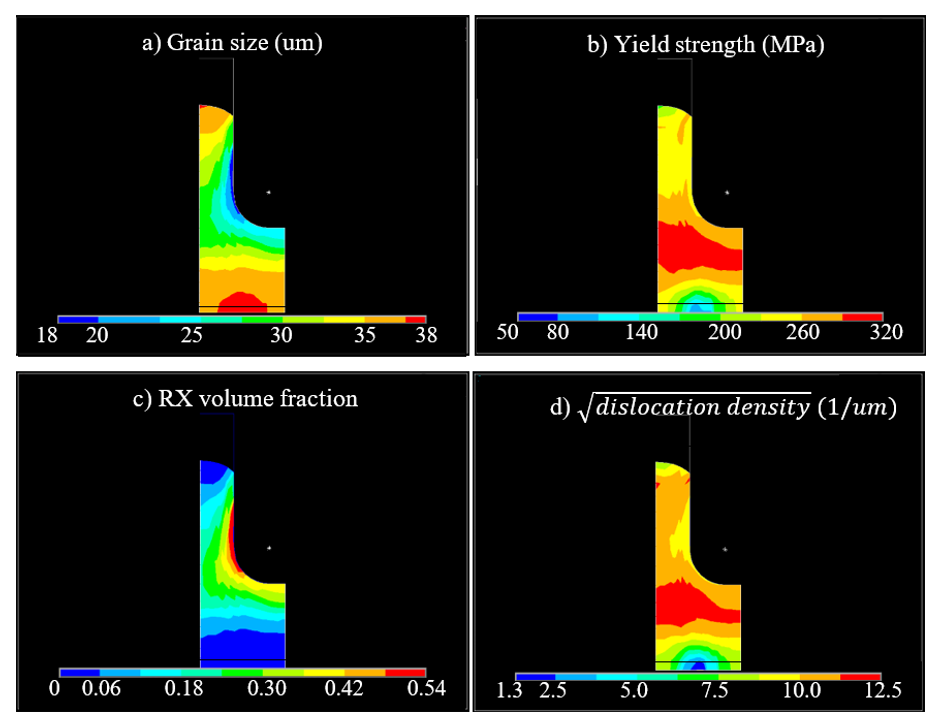
IN718 forging Ansys
Dynamic recrystallization during industrial-scale 3D forging of IN718 superalloy, with PanLink connecting Ansys to PanEvolution and clustering elements to cut redundant calculations.
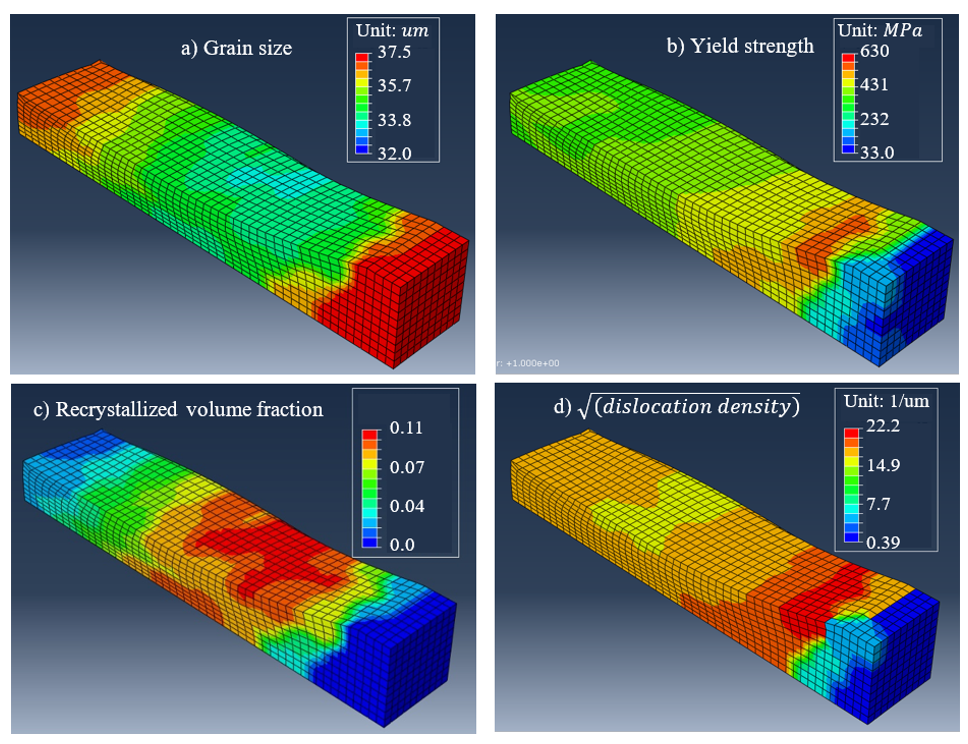
Rolling Abaqus
Average grain size, yield strength, recrystallized volume fraction and dislocation density distributions predicted during a rolling pass.
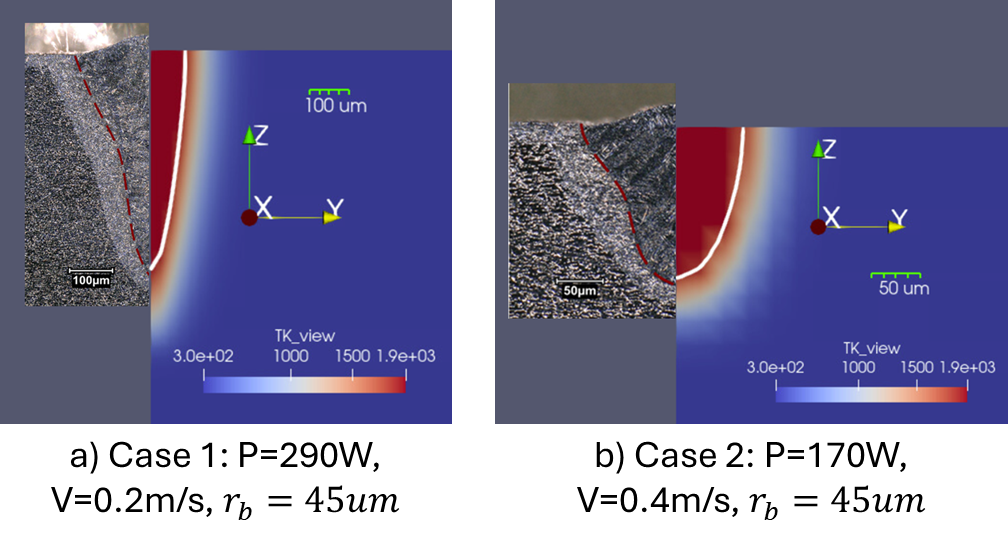
Laser powder bed fusion MOOSE
Ti-6Al-4V LPBF in keyhole and conduction modes on a 68,474-element mesh. PanLink supplies heat capacity, thermal conductivity, density, CSI and SDAS from local history, with 10,000 clusters. Melt pools agree with published cross-sections.
AD730 solution heat treatment MOOSE
A turbine blade with a cooling channel, over 18,000 elements, under a 1060–1110 °C gradient. Concurrent primary γ′ dissolution and grain growth with Zener pinning over 10,000 s using 300 clusters, in good agreement with experimental data (Alvarado et al., Metals, 2021).
Ti-6Al-4V solidification MOOSE
A 100×100 grid with 100 clusters and cooling rates from 600 to 1000 °C/s. Spatially varying CALPHAD properties from local solidification conditions: the highest cooling rate gives the maximum CSI and the lowest Gibbs energy.
References
- Cao, W., Zhang, F., Kadirvel, K., Chen, S., Payton, E., & Krug, M. (2025). PanEvolution: Integrating CALPHAD, microstructure modeling, and finite element method. Calphad, 90, 102851. https://doi.org/10.1016/j.calphad.2025.102851
- Cao, W., Kadirvel, K., Liu, Q., Chen, S., Zhang, C., Liang, S., Zhu, J., Oh, H., & Zhang, F. (2026). A high performance CALPHAD data engine for scalable ICME and AI-assisted materials design. Scientific Reports, 16, 36147. https://doi.org/10.1038/s41598-026-73329-6
Your solver. Pandat’s thermodynamics. At billion-call scale
PanLink is part of the third-generation Pandat software and uses the same calculation engines and thermodynamic and kinetic databases. We look forward to working with researchers and industry partners to explore new applications. Contact us to discuss integrating PanLink with your simulation workflow.